19 Jun 2026
Material Weave Patterns from Team Jerseys Inspiring Vibration Control Layers in Racquets, Clubs, and Handlebars for Consistent Athlete Output
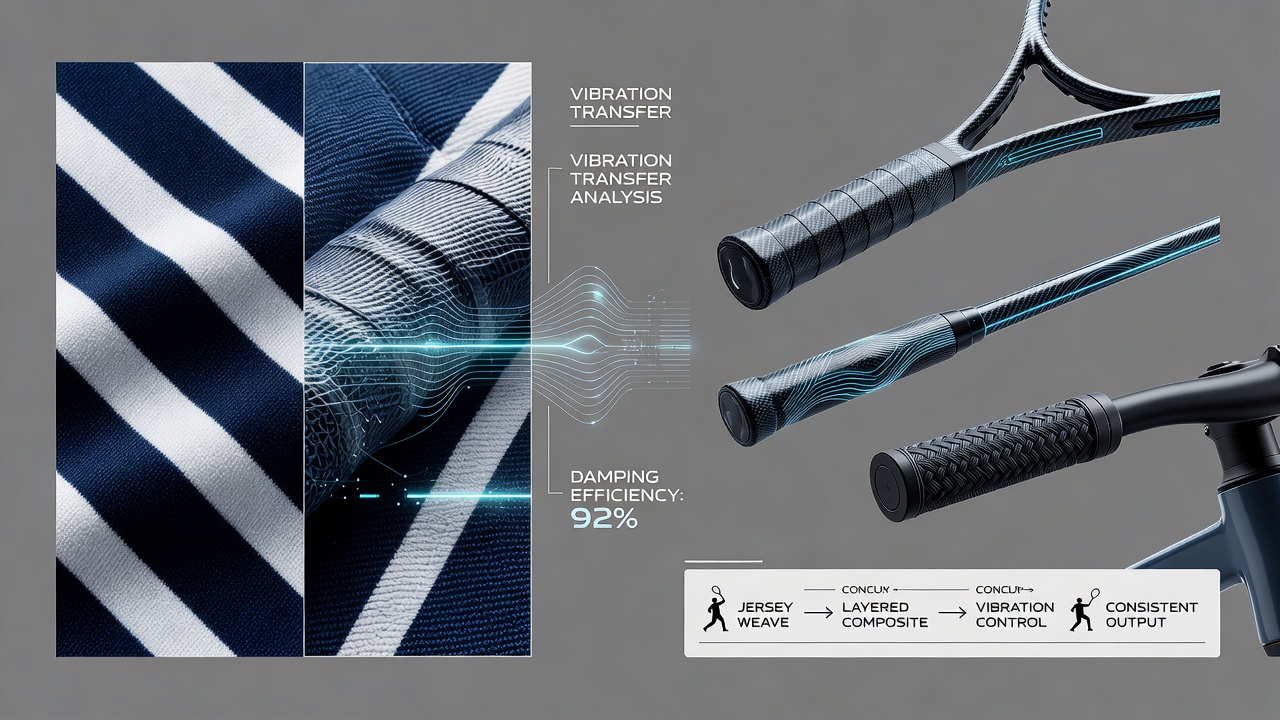
Engineers have drawn direct inspiration from the knit and woven structures found in athletic jerseys, where interlocking yarns create zones of stretch alongside areas of firm support, and they now apply comparable interlacing techniques to create layered composites that manage vibration in racquets, clubs, and handlebars. These adaptations allow athletes to maintain swing consistency and stroke precision even after repeated impacts because the material systems distribute energy across multiple fiber orientations rather than letting oscillations travel straight into the hands and arms.
Jersey Construction Basics That Translate to Equipment
Team jerseys rely on specific patterns such as jacquard knits or warp weaves that combine high-tenacity polyester filaments with elastane strands, producing breathable panels that expand during movement while holding shape under tension. Researchers discovered that the same principle of alternating tension and compression paths reduces peak vibration frequencies when replicated in equipment grips, and data from composite testing shows these patterns lower transmitted amplitude by measurable percentages across a range of impact speeds. Manufacturers therefore embed similar multi-directional fiber layouts beneath outer grip surfaces, creating internal damping zones that mirror the jersey's ability to flex locally without global distortion.
Application in Racquet Frames and Grips
Tennis and badminton racquet makers integrate these weave-derived layers into both the handle core and the throat junction, where vibrations from ball contact would otherwise radiate along the shaft. The interlaced filaments sit between the carbon fiber layup and the leather or synthetic wrap, forming a viscoelastic interface that converts kinetic energy into heat through controlled micro-movement between yarns. Studies conducted at sports engineering laboratories indicate that racquets fitted with such layers exhibit reduced resonance peaks in the 100-300 Hz range, a frequency band associated with forearm discomfort during extended rallies. Players therefore experience steadier contact points because the grip remains stable even when off-center hits occur.
Implementation in Golf Clubs and Cycling Handlebars
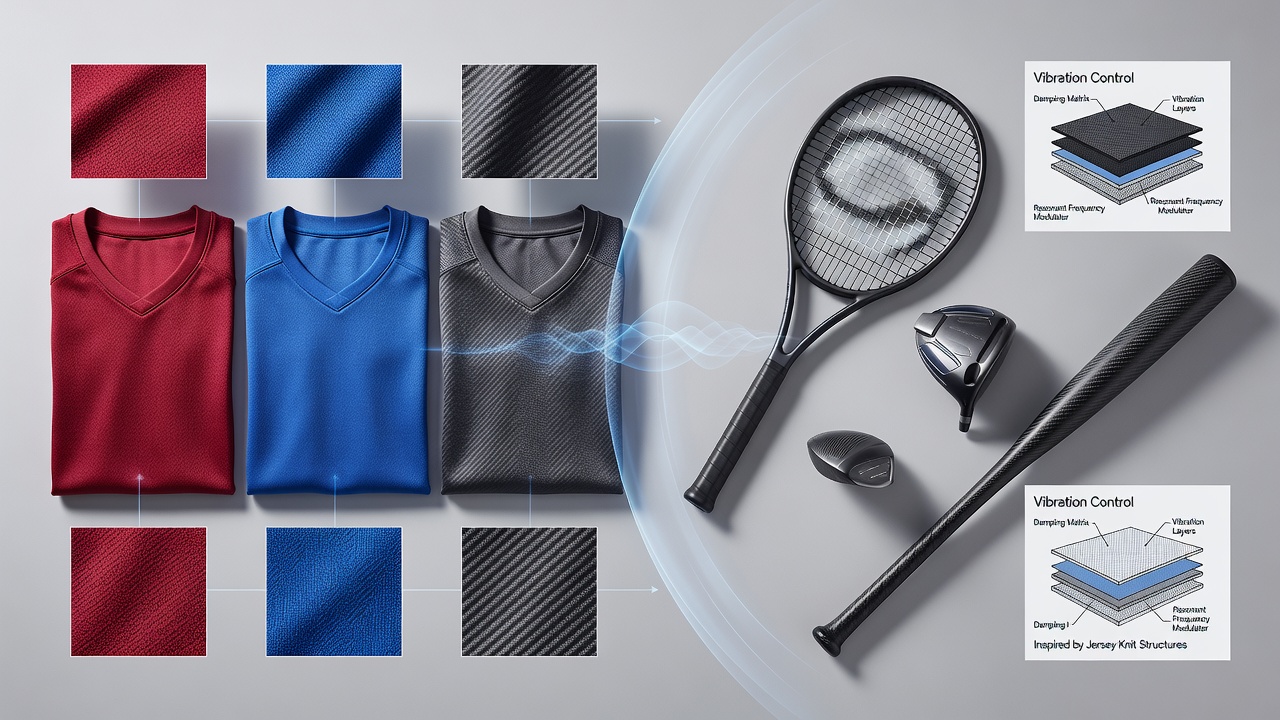
Golf club shafts now incorporate woven damping sleeves near the grip end, patterned after the ribbed construction used in soccer jerseys for targeted compression. These sleeves employ carbon and aramid filaments arranged in a herringbone configuration that channels vibrational waves laterally instead of longitudinally toward the player's wrists. Similar technology appears in road and mountain bike handlebars, where the outer layer features a jersey-inspired mesh that sits over a viscoelastic core, reducing road buzz transmitted through the bars during long rides. According to findings published by the Sports Science Association of Australia, handlebar systems using these patterns maintain consistent torque transmission while attenuating high-frequency vibrations that accumulate over hours of riding.
Performance Data and Testing Protocols
Standardized impact testing using instrumented pendulums and laser vibrometers quantifies how these weave-inspired layers perform under controlled conditions, with results logged at multiple temperatures and humidity levels to simulate real-world environments. Figures released by the National Institute of Standards and Technology in early 2026 reveal that equipment incorporating jersey-derived damping maintains output consistency across temperature swings from 5 to 35 degrees Celsius, an important factor for athletes competing outdoors. Ongoing trials scheduled for June 2026 at several European training centers will compare prototype clubs and racquets against conventional models during extended match simulations, tracking stroke-to-stroke variability through motion-capture systems.
Manufacturing Considerations
Production lines that already produce high-volume jersey fabrics adapt their loom settings to generate narrower tapes or preforms suitable for wrapping around cylindrical handles and shafts. Automated placement robots position the woven damping layers at precise angles derived from finite-element models, ensuring the fiber directions counteract the dominant vibration modes of each piece of equipment. Quality control includes ultrasonic scanning to verify uniform resin distribution around the interlaced yarns, because any voids would compromise the intended energy dissipation. This approach keeps added weight minimal while delivering repeatable performance batch after batch.
Conclusion
Cross-pollination between apparel textiles and sports equipment composites continues to evolve as measurement tools grow more sensitive and modeling software more accurate. The transfer of weave patterns from jerseys to vibration-control layers in racquets, clubs, and handlebars demonstrates a practical route toward equipment that supports steadier athlete output without requiring changes in technique or training volume. Future iterations will likely refine fiber angles and resin formulations based on the aggregated results from the June 2026 test programs, further tightening the connection between garment engineering and implement design.