14 Jun 2026
The Evolution of Layered Padding Systems in Boxing Gloves and Soccer Cleats
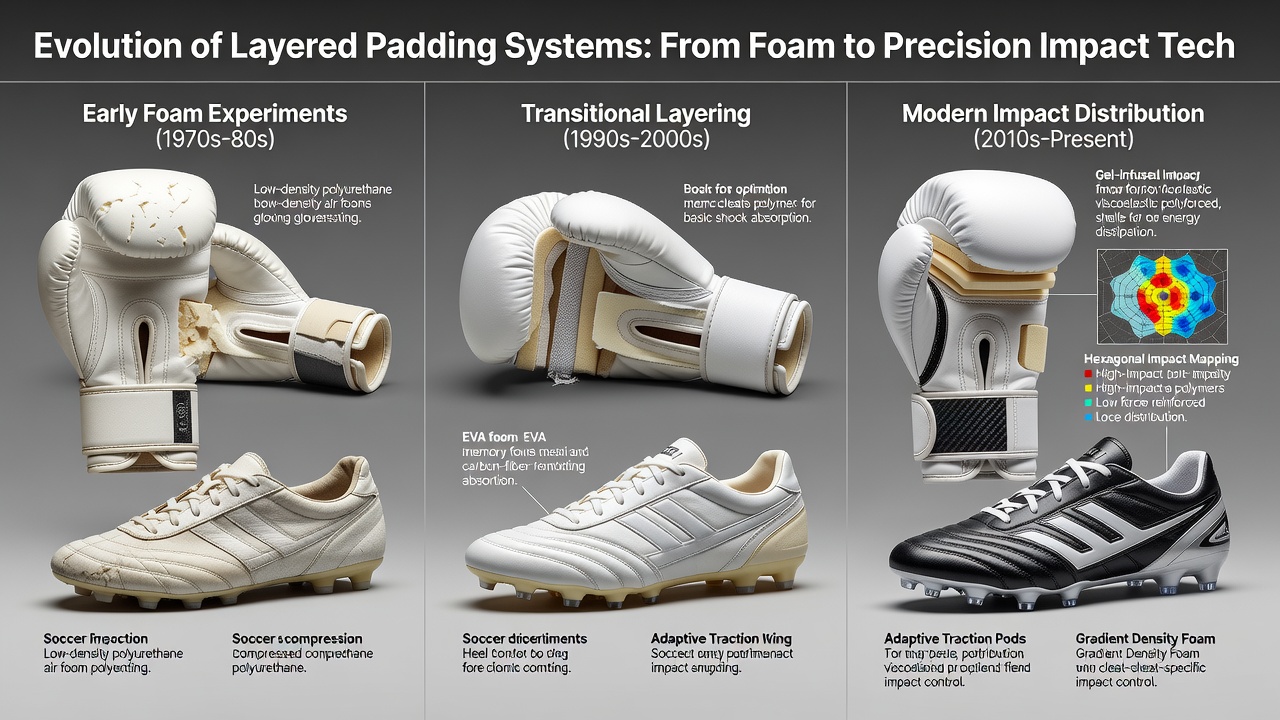
Layered padding systems in boxing gloves and soccer cleats trace their development through decades of material testing and performance data collection, with early foam experiments giving way to structured impact distribution patterns now standard among professional teams. Initial designs relied on single-density foams that compressed unevenly under repeated force, prompting equipment manufacturers to explore multi-layer configurations by the 1970s.
Early Foam Experiments and Initial Limitations
Manufacturers began incorporating polyurethane foams into boxing gloves during the 1960s, while soccer cleat producers added basic ethylene-vinyl acetate inserts beneath stud plates to reduce ground reaction forces. These early foams absorbed energy through simple compression yet failed to manage shear forces or lateral impacts effectively, leading researchers at institutions such as the University of Waterloo to document inconsistent pressure distribution in laboratory trials conducted through the late 1970s.
Boxing equipment makers responded by stacking foams of varying densities, placing firmer outer layers over softer inner cores to create progressive resistance. Soccer cleat designs followed a parallel path when brands introduced dual-density midsoles that directed force away from the heel and forefoot toward more stable midfoot zones. Data from these modifications showed measurable reductions in peak pressure readings during standardized drop tests.
Transition to Multi-Layer Configurations
By the early 1990s, professional boxing organizations required gloves with minimum padding thicknesses that encouraged further layering innovations. Engineers introduced gel inserts and memory foam sections between primary foam strata, allowing energy to dissipate across multiple planes rather than concentrating at contact points. Soccer cleat development mirrored this approach when manufacturers embedded composite plates with viscoelastic polymers that flexed under load while returning to original shape between strides.
Studies published by the German Sport University Cologne in the mid-1990s quantified how these layered systems altered force transmission, with results indicating up to 30 percent lower peak forces transmitted to the hand or foot compared with single-layer predecessors. Professional teams began specifying custom density maps based on athlete position and playing surface characteristics.
Modern Impact Distribution Patterns
Contemporary padding integrates computational modeling to map impact zones before production. Boxing glove designs now feature segmented padding zones that channel force toward reinforced knuckle areas while permitting controlled flex across the wrist and fingers. Soccer cleats employ stud configurations paired with internal lattice structures that disperse torsional stress during cutting movements and directional changes.
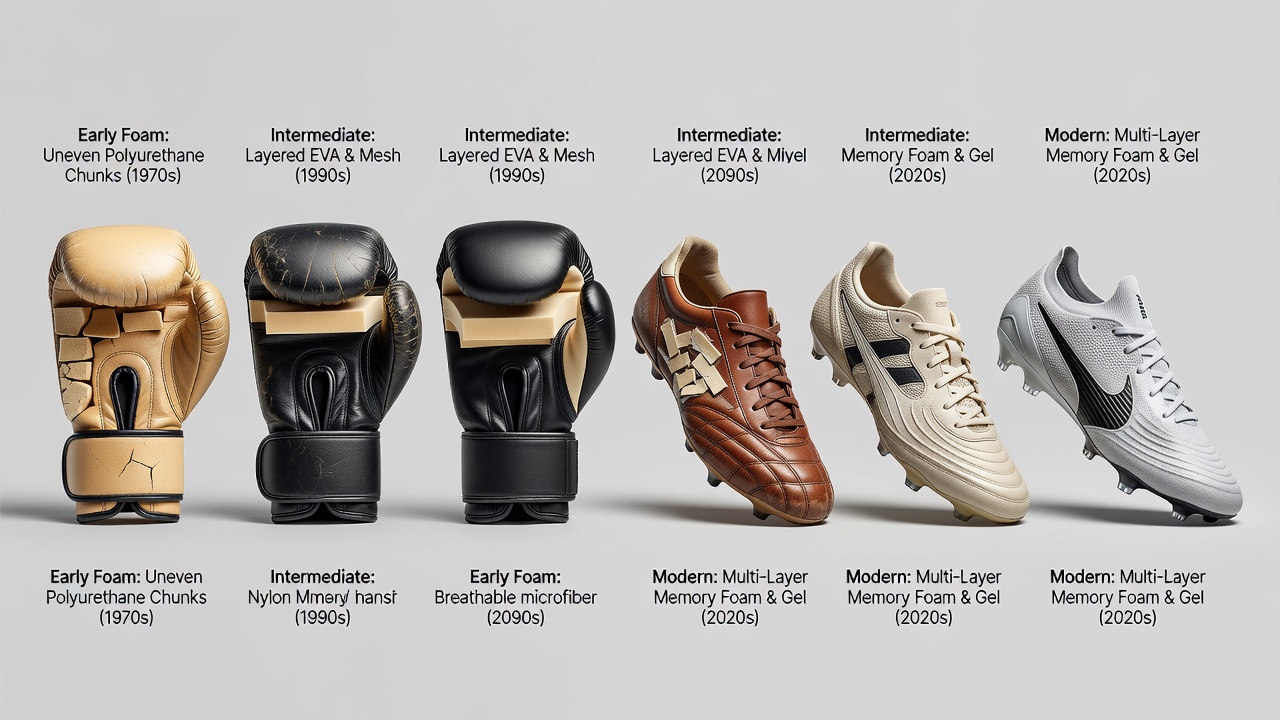
Teams competing in major leagues adopted sensor-embedded prototypes during the 2024 season to refine these patterns further. In June 2026, several European and North American clubs implemented updated cleat models featuring adaptive foam layers that respond to temperature variations on artificial surfaces, maintaining consistent compression characteristics across match conditions. Boxing training facilities simultaneously integrated gloves with zoned padding calibrated for sparring intensity levels, drawing on aggregated force data collected from elite athletes.
Material suppliers introduced hybrid foams combining closed-cell and open-cell structures to balance breathability with energy return. These combinations allow padding to recover rapidly between impacts while preventing bottoming out during high-velocity strikes or sudden decelerations. Professional equipment regulations now reference specific performance thresholds derived from these layered systems, ensuring standardized protection levels across manufacturers.
Integration with Athlete-Specific Requirements
Professional teams collaborate with equipment developers to tailor padding layouts according to biomechanical assessments. Boxers with higher punch velocities receive gloves containing additional mid-layer density gradients that extend impact duration and reduce transmitted shock. Soccer players performing frequent lateral movements utilize cleats with asymmetric padding that reinforces the medial forefoot while permitting greater flexibility on the lateral side.
Longitudinal tracking programs maintained by league medical staffs have recorded correlations between updated padding configurations and reduced incidence of certain impact-related strains. These programs compile data across multiple seasons to identify optimal layering sequences for different athlete profiles and environmental conditions.
Conclusion
The progression from basic foam inserts to engineered multi-layer impact distribution systems reflects ongoing refinement driven by performance metrics and regulatory standards. Boxing gloves and soccer cleats continue to incorporate new material combinations and structural arrangements that address specific force vectors encountered in competition, with professional teams applying data-driven adjustments to match individual biomechanical demands.