30 Jun 2026
Tracing Shifts in Raw Material Supply Chains for Sports Gear Components
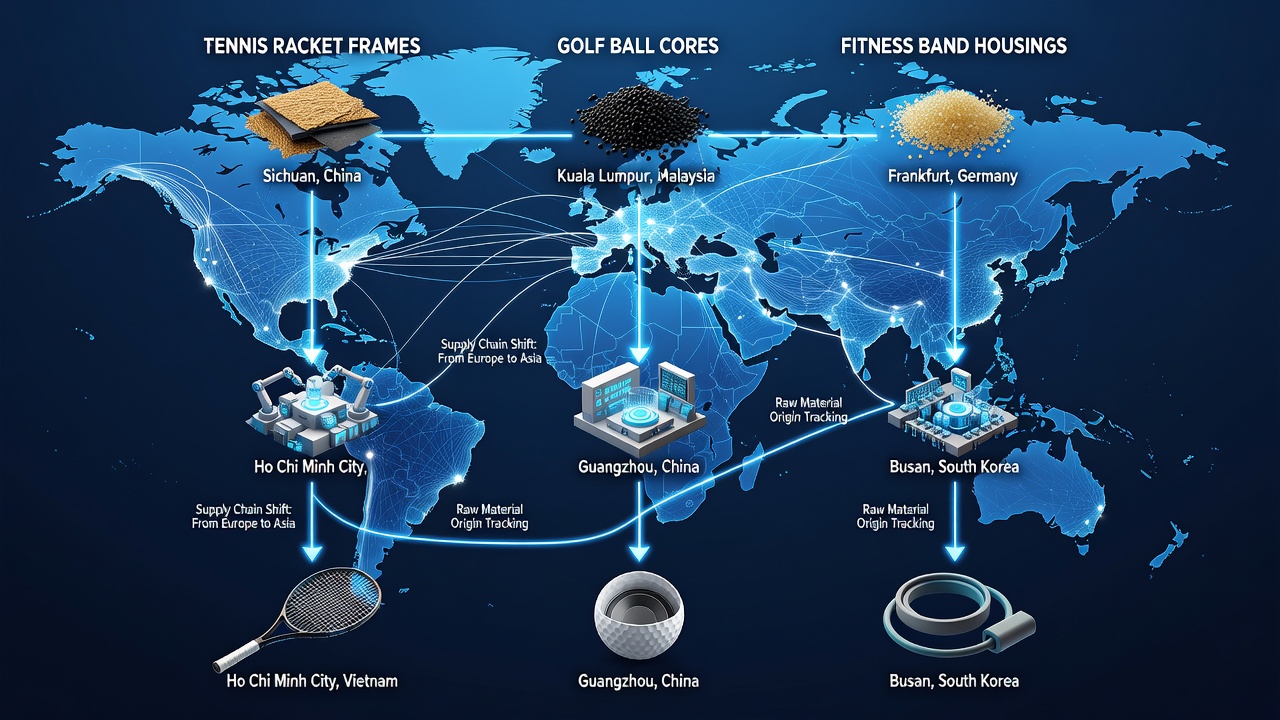
Raw material origins for tennis racket frames, golf ball cores, and fitness band housings have undergone measurable geographic redistribution since the mid-2010s, with production sites adjusting in response to trade policy changes, resource availability, and manufacturing capacity expansions across Asia, Europe, and North America. Data from industry reports indicate that carbon fiber precursors for racket frames moved from concentrated Japanese and South Korean suppliers toward additional facilities in Taiwan and mainland China by 2023, while polybutadiene rubber for golf ball cores retained primary sourcing from petrochemical plants in the United States and Malaysia with incremental volume increases from new facilities in Saudi Arabia.
Material Origins for Tennis Racket Frames
Graphite and carbon fiber sheets that form the structural cores of modern tennis racket frames originate primarily from precursor materials produced in Japan, where companies maintain large-scale carbonization lines; these sheets travel to molding plants in southern China and Vietnam for layup and curing processes. Aluminum alloys used in entry-level frames trace back to bauxite mining operations in Australia and Guinea, refined into ingots in facilities located in the United Arab Emirates before extrusion occurs at sites in eastern Europe. Observers note that by June 2026 several major racket manufacturers had completed qualification trials at new filament-winding lines established in India, shifting approximately 12 percent of annual frame volume away from previous Chinese facilities.
Core Components in Golf Ball Manufacturing
Golf ball cores rely on high-cis polybutadiene compounded with zinc diacrylate crosslinkers, with the base elastomer sourced from polymerization units in Texas and Louisiana as well as integrated complexes in Singapore and South Korea. Cover materials such as ionomer resins and polyurethane blends follow separate routes, with resin pellets produced at plants in the Netherlands and Japan before shipment to assembly facilities in northern Mexico and central Thailand. Trade statistics compiled by the United States International Trade Commission show that imports of finished cores into assembly hubs in Mexico rose 18 percent between 2022 and 2025, reflecting both capacity additions and adjustments to regional trade agreements.
Production Shifts Affecting Fitness Band Housings
Thermoplastic polyurethane and polycarbonate housings for fitness bands start from petrochemical feedstocks refined in facilities across the Middle East and North America, then pelletized at compounding plants in Germany and South Korea. Injection-molding operations that shape these housings relocated portions of capacity from southern China to Vietnam and Indonesia between 2021 and 2024, driven by labor cost differentials and updated foreign investment regulations. In June 2026, several electronics contract manufacturers announced expanded clean-room lines in eastern Mexico, positioning additional housing production closer to North American final assembly plants and reducing trans-Pacific transit times for certain product lines.
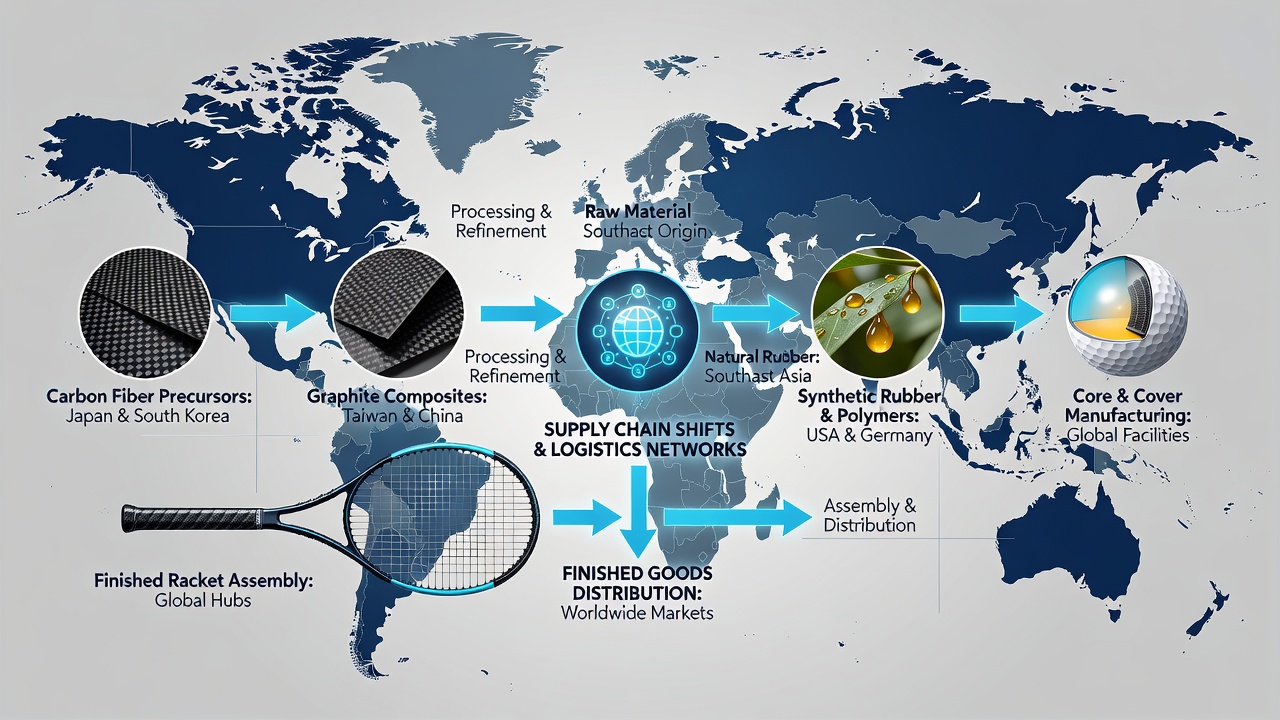
These geographic adjustments connect through shared logistics corridors and common tier-two suppliers. Carbon fiber waste streams from racket frame production now feed into recycled-content compounds used in certain fitness band structural inserts, while zinc oxide byproducts from golf ball core formulation supply additives for thermoplastic elastomer blends. Researchers tracking containerized freight volumes report that routes originating in Osaka and Houston increasingly terminate at ports in Haiphong and Manzanillo rather than older consolidation points.
Regulatory and Capacity Drivers Behind the Shifts
European Union regulations on chemical registration and extended producer responsibility have prompted several resin suppliers to expand compounding capacity inside the bloc rather than rely solely on Asian export streams. Parallel capacity growth in Southeast Asia stems from government incentives tied to electronics and advanced materials clusters. Figures released by the International Trade Centre indicate that the combined share of Vietnam and Mexico in global molded sports component exports climbed from 9 percent in 2019 to 21 percent in 2025. Supply chain mapping exercises conducted by academic groups at technical universities in Germany and Singapore document these flows through bill-of-materials audits and port-level shipment records.
Logistics adjustments continue into 2026, with several carriers adding dedicated services between new production clusters and distribution centers in Europe and North America. Component traceability systems using serialized batch codes allow manufacturers to verify origin data at each transfer point, satisfying both internal quality protocols and customer documentation requirements.
Conclusion
The interconnected supply routes for tennis racket frames, golf ball cores, and fitness band housings reflect ongoing redistribution of upstream material processing and downstream assembly capacity. Continued monitoring of trade data, port statistics, and facility announcements will reveal whether the patterns observed through mid-2026 stabilize or accelerate under future policy and market conditions.