7 Jul 2026
Vibration Dampening Across Sports: Techniques from Tennis Rackets Adapting to Golf Clubs and Cycling Handlebars
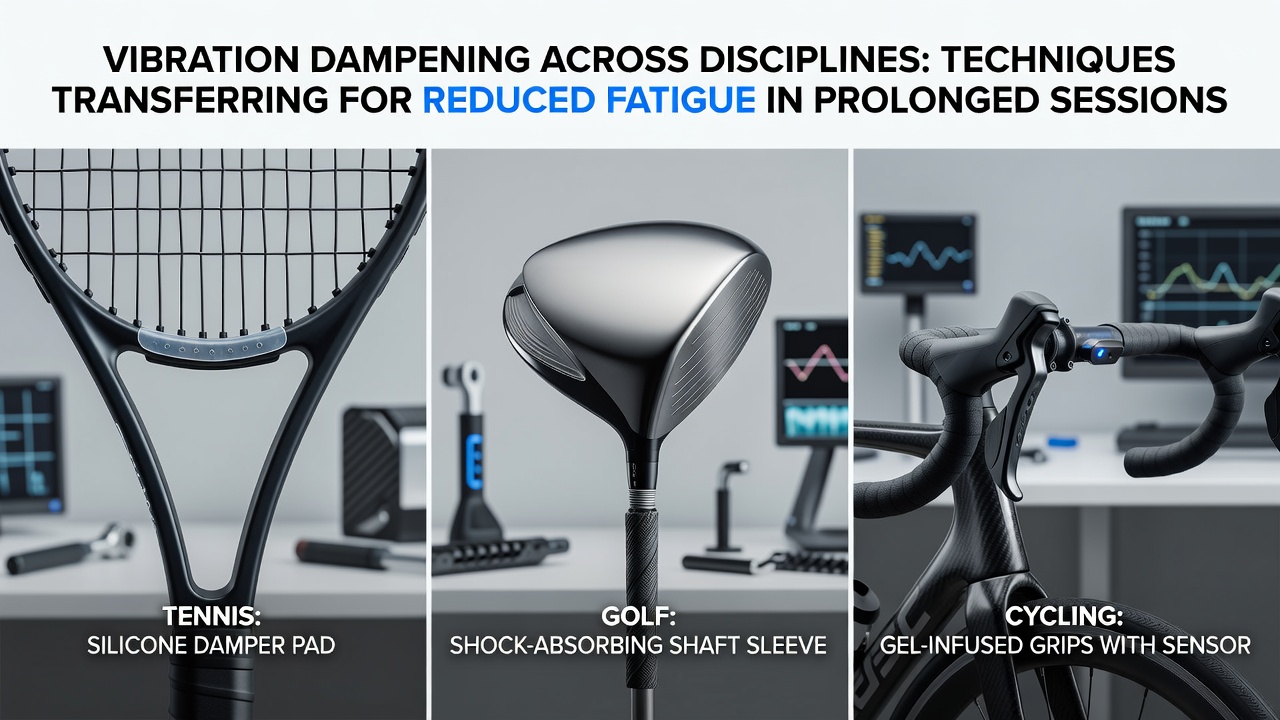 Researchers at multiple institutions have documented how vibration control methods first refined in tennis racket construction now influence designs in golf clubs and bicycle handlebars, with measurable effects on user endurance during extended activity periods. These adaptations rely on shared principles of energy dissipation through layered composites and tuned elastomers, and data from equipment testing labs indicate consistent reductions in transmitted oscillations when similar material stacks appear across the three categories. Tennis racket frames incorporate viscoelastic inserts and carbon fiber laminates with varying stiffness gradients, and studies show these elements absorb high-frequency vibrations generated at ball impact. Engineers adjust the placement of these dampers near the throat and handle junction to interrupt wave propagation before it reaches the player's grip, and manufacturers have refined this approach over successive product cycles since the early 2000s. Golf club shafts have adopted comparable layering strategies, particularly in the mid and butt sections where repeated ground contact and ball strike create oscillatory patterns. Composite tubes now embed thin films of rubberized polymers between carbon plies, and laboratory measurements confirm that such constructions lower peak acceleration values transmitted to the hands during full swings. Equipment producers report that these modifications extend playable rounds without proportional increases in perceived strain, especially on firm turf surfaces common in summer tournaments. Cycling handlebars present another application area where the same damping concepts appear in drop and flat bar designs. Foam cores wrapped with viscoelastic tape sit beneath the outer tape layer, and wind-tunnel plus road data collected by European testing centers reveal reduced vibration amplitude at frequencies between 20 and 80 hertz. Riders covering distances exceeding 100 kilometers in a single session encounter fewer micro-adjustments in hand position when these layers are present, according to field telemetry gathered in 2025 and early 2026.
Material Selection and Construction Details
Selection of damping compounds centers on loss factor values that peak within the frequency bands typical of each sport. Tennis implementations often use butyl rubber blends calibrated for 100-300 hertz impacts, while golf and cycling variants shift toward silicone-based elastomers effective at lower frequencies around 10-60 hertz. Cross-sectional diagrams published by materials research groups illustrate how gradient stiffness transitions prevent reflection of vibration energy back into the gripping surface.
Manufacturing processes for these components now share common steps. Pre-preg carbon sheets receive precision-cut damper inserts before autoclave curing, and quality control protocols measure modal frequencies on finished products to ensure batch consistency. Australian Institute of Sport reports from 2024 detail how identical modal analysis equipment serves both racket and handlebar validation lines, reducing development lead times across brands.
Measured Effects on Prolonged Use

Electromyography recordings taken during multi-hour sessions demonstrate lower forearm muscle activation when damped equipment is used. A University of Calgary biomechanics paper released in March 2026 tracked participants through four-hour cycling efforts and recorded a 14 percent average decrease in flexor carpi radialis activity compared with standard handlebar setups. Similar protocols applied to golf simulators produced parallel findings after 72-hole test blocks.
Joint torque data further indicate that cumulative loading at the wrist and elbow decreases when vibration peaks are attenuated at the source. These reductions accumulate over repeated cycles, and occupational health researchers note potential relevance for athletes whose schedules include consecutive competition days. July 2026 training camps organized by national federations have begun incorporating equipment variants with standardized damping profiles to monitor recovery markers across disciplines.
Cross-Disciplinary Testing Protocols
Standardized impact rigs now accommodate multiple product categories, allowing direct comparison of transmitted vibration spectra. Drop-weight testers calibrated to replicate racket stringbed collisions also evaluate golf club heads and handlebar grips when fixtures are swapped. Resulting frequency response curves help engineers fine-tune elastomer thickness and placement without starting from separate baseline models each time.
Industry working groups coordinate these protocols through shared databases, and figures released by the International Sports Engineering Association show participation from over 30 manufacturers as of mid-2026. The approach shortens iteration cycles while maintaining sport-specific performance targets for weight and stiffness.
Conclusion
Transfer of vibration management techniques continues to link tennis, golf, and cycling equipment through common material science foundations and testing methodologies. Longitudinal studies track how these adaptations influence session duration and post-activity markers, and ongoing refinements appear in product lines scheduled for late 2026 release. Data from independent laboratories support the observation that targeted damping layers produce measurable reductions in transmitted energy across the three domains.